• Posted on August 02, 2010

Yer Luvin’ Uncle Bert

Bert Fegg’s Nasty Book for Boys and Girls was, without a doubt, my favourite book as a teenager. I found it in the bargain bin at a Cole’s bookstore in 1979, or maybe 1980. If I remember correctly, a shaft of light came down from the heavens and illuminated the word ‘Nasty‘, and I was powerless to resist. Also, it was a buck. I’ve had many serendipitous moments in bookstores, but clearly the hand of god was involved in this transaction.

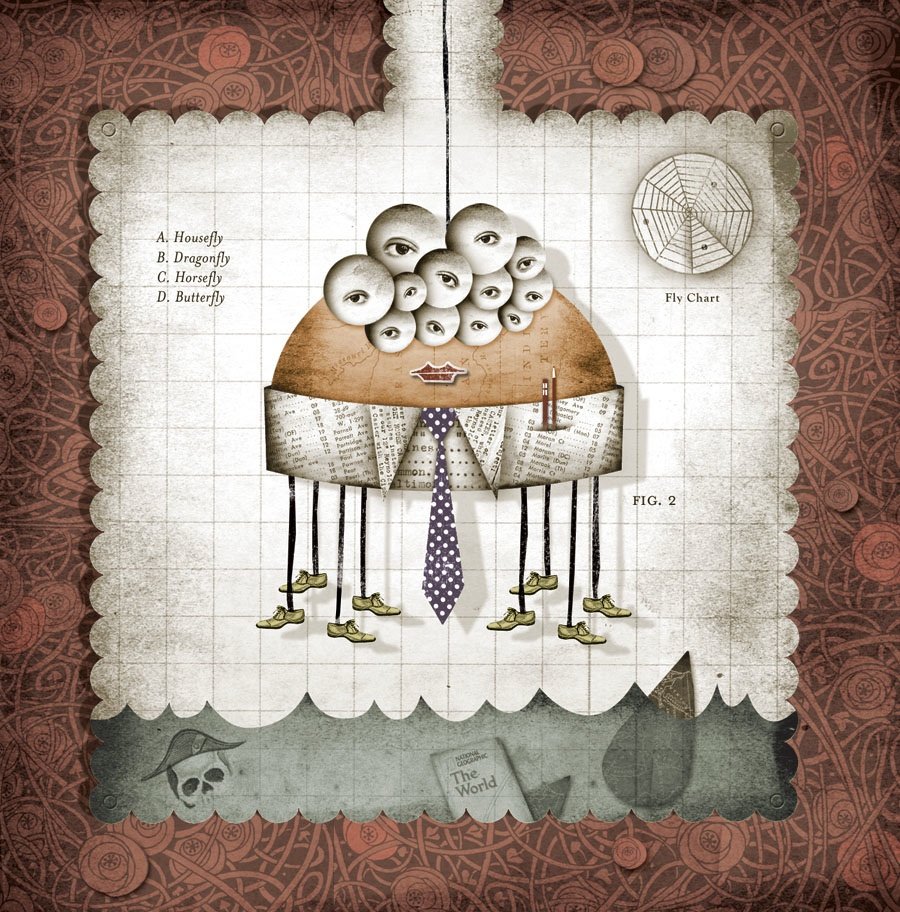
The book is supposedly written by Bert Fegg, a disheveled and bulbous crank, but this assemblage of wiseacrey is in fact, penned by Terry Jones and Michael Palin, of Monty Python fame. It is not unlike an episode of MPFC in the variety of content, but it has, you know, more words. And the sarcasm is directed toward traditional children’s fare such as school texts, annuals, games, and comic strips. It’s a beautiful mash-up of satire and silliness, packaged and illustrated by Martin and Lolly Honeysett, who have a definite Gilliamesque flare for the absurd. The mostly black & white illustrations of pervy scribes, Turkish Wall Goats, and inebriated dogs had a huge influence on my drawing style as a kid. Suffice to say, I was never the same after Bert Fegg’s Nasty Book For Boys and Girls.
Read More

  • Posted on July 26, 2010

Thing-Thing

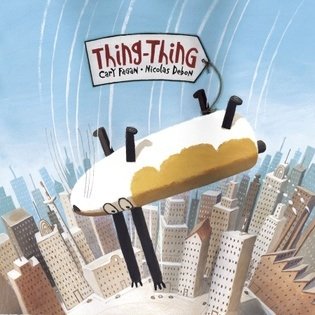
The thing about Thing-Thing is that hesitation is not always the best policy, which contradicts everything I said in my previous blog about mindless accumulation. I first identified Thing-Thing as a jewel worthy of plucking about a year ago. The title, in particular, appealed to me, as did the art, but for some reason, I hesitated. Thing-Thing was a one of one in the bookstore, and it stayed that way for six months, until the day it disappeared from the shelf. The day, of course, when I finally realized it was time to bring Thing-Thing home. Presumably, the book had been sent back to the publisher, but maybe someone less diffident than me had picked it up. I hope so. Books that are returned to the publisher eventually get sent back on giant lots with other ‘remainder’ stock, only this time, the sad history of their early rejection is slashed across their bottoms with a big black marker. I was able to retrieve the book from the publisher before it suffered a completely undeserved fate. Thing-Thing is now my Thing-Thing, and it is most assuredly one of my favourite things.

It begins with a spoiled brat named Archibald Crimp (Dickens would approve) throwing a hissy fit, declaring that he is ‘not getting out of this bed‘ (Naomi Campbell would approve) until his parents bring him a present better than all the electronic games, racing cars, and robots littering the floor of the hotel room in the BIG CITY, where the family is staying for the little snot’s birthday. The exasperated, but pathologically indulgent parents oblige, and the father heads over to the nearest toy store. There, on a top shelf, he finds Thing-Thing, who was ‘not quite a bunny rabbit, but not quite a dog either, nor a bear, or cat for that matter.’ Dad brings the toy home and Little Lord Archibald promptly throws it out the window. End of story? No. Thing-Thing’s slow descent to the pavement is where the story actually begins.

Read More

  • Posted on July 19, 2010

On the Pleasures and Perils of Accumulation

Guess Who's Coming for Dinner?

Sometimes it’s just too much. I fall for a pretty face in a bookstore, take the book home, and then think, ‘why did I buy this?’ After many years working in an independent bookstore, and in the years beyond, I’ve accumulated many such indulgences. It’s bibliophelia in combination with a bit of shopaholism and a soupçon of misplaced affection. Every so often I feel compelled to bring a book home, even when I know it’s not true love. I wish to support bookstores, authors, illustrators, and in particular, the continued publication of high quality (printed) picture books, but funds and especially space are limited. If the thrill starts to wane a day or two after I’ve purchased a book, or worse, as I’m walking out of the store, it’s a sign that something other than affection was driving my decision. I try to buy only what I love, but sometimes I mistake admiration for love, and even that can be complicated by other factors which inevitably lead to misunderstandings, and an accumulation of unwanted books on my shelves. I suppose this is true of any sort of over-consumption of mood-altering substances, even those that are printed and bound.

Read More

  • Posted on July 10, 2010

Splendour in the Grass

The Garden is a miraculous place, and anything can happen on a beautiful moonlit night.

Yes. If summoned by the Brave Good Bugs, Leaf Men might swoop down from the trees, shoot a spider queen through the heart with an arrow made of thistle, save the life of an old lady and tend the garden. It could happen.

More importantly, you wish it could happen.

Most folks have a mental list of creative go-to’s: actors, writers, painters, chocolate manufacturers, etc., they will turn to over and over again for inspiration, stimulation, and pleasure. My list includes illustrators, and William Joyce has long been a charter member of this small group of artists who wander through the visual reference library in my brain, hanging and re-hanging paintings, tweeking the database, adding something new to the permanent collection every now and then.

The Leaf Men and the Brave Good Bugs is not new, but it’s quintessential Joyce: whimsical in the truest sense of the word, strange in any sense of the word, staggeringly gorgeous, narrative, and reverential. Joyce somehow manages to make his books feel cinematic, like old-timey movies, in particular screwball comedies and Errol Flynn adventures, with just a touch of sentimentality. This is especially true of A Day with Wilbur Robinson, another great Joyce picture book, but it is also present in The Leaf Men and the Brave Good Bugs. The only requirement is a comfortable chair and a big bowl of buttered popcorn.

Read More

  • Posted on June 30, 2010

Fox On The Run

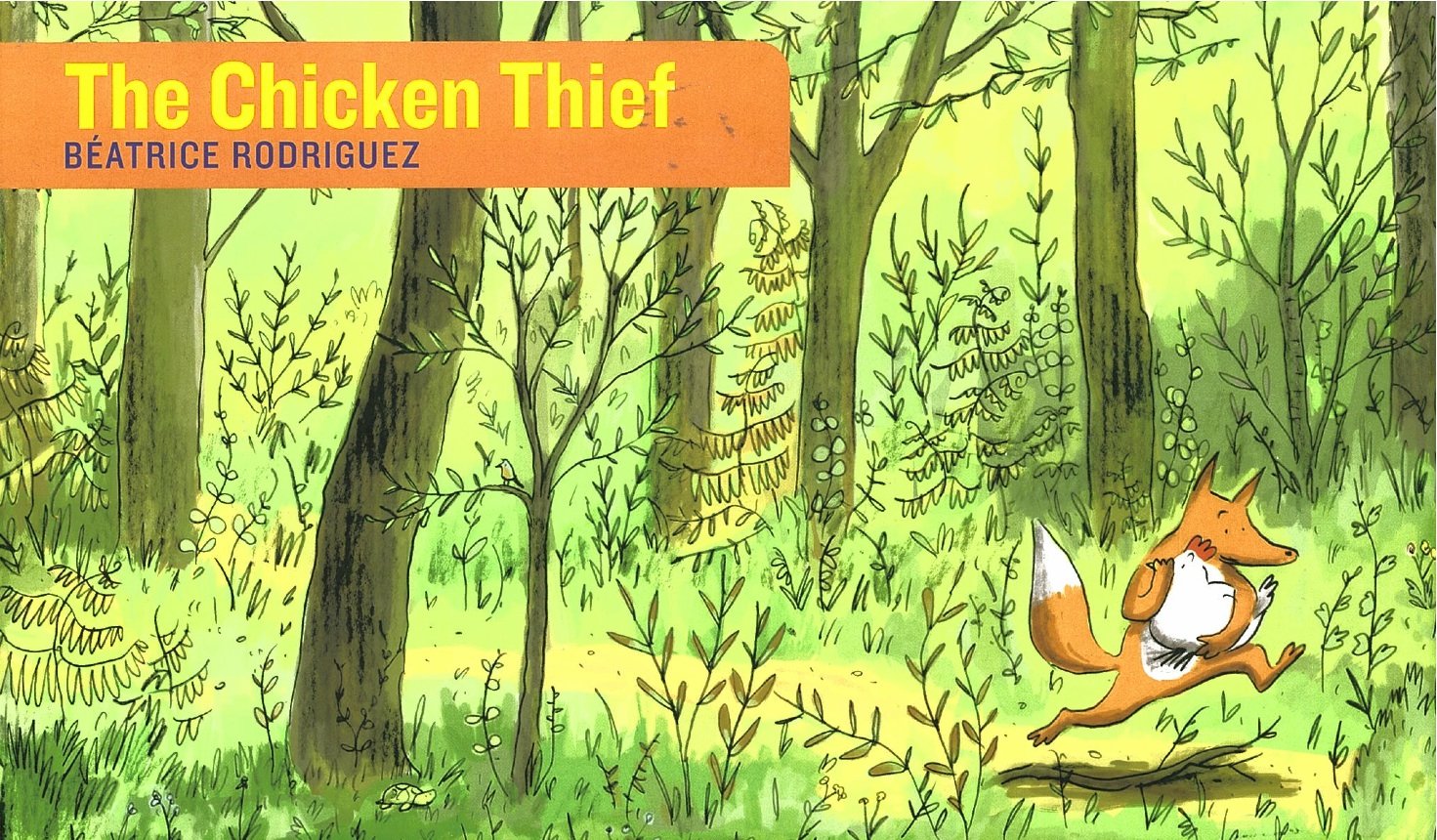
A funny thing happened on the way to a barnyard convention. A fox steals a chicken, and as one would expect, a chase ensues, but this is no ordinary poultry pilfering. There will be no KFC party pack on the menu tonight.

The Chicken Thief is an action-packed wordless picture book involving a cross-country chase through dark forests, steep mountains, and roiling oceans. The watercolour and chalk paintings are loose in detail, but rich in colour, providing a glowing background for the expressive line drawings of the main characters: the chasers-a bear, rabbit and rooster, and the chasees-a fox and a hen. One wonders why the fox went so far afield to find his hen, but being a fox, I’m sure he had a plan. A sly plan. But not even a fox could imagine the conclusion to this unusual story.

Read More

  • Posted on June 20, 2010

Even Rabbits Get the Blues

OK. Let me just get it out there…

About 10 years ago I wrote a children’s story about a boy and his snit. The snit is disembodied from the boy; it’s an actual thing that he gets in and out of, and it gets bigger or smaller depending on the severity of the provocation. My intention was to illustrate the damn thing, but it never got past the ‘why don’t I clean out my closet’ stage of the creative process. Now, here is a book, Big Rabbit’s Bad Mood, which is similar in the sense that the rabbit’s bad mood is an externalized grey thing that follows him around, “lying in his living room, on his sofa, picking its nose and wiping its boogers on his carpet.” No boogers in my book, but you see my point. And…Big Rabbit’s Bad Mood is truly wonderful; funny…silly, and the illustrations are, well, the illustrations are done.

Delphine Durand is a French artist who has a particular and admirable talent for noses. Durand’s illustrations of pendulous probosci are what attracted me to her previous books, Beetle Boy and Peter Claus and the Naughty List. It’s a peculiar thing to possess such skill in the humourous depiction of noses, but it’s just one part of a larger gift for characterization. Her little creatures, beetles, dolls, children, rabbits, to name a few, are crazy funny and deliciously strange. Delphine is one of those artists whose stylistic influence is so strong you can see it creeping into other peoples work. But then, she keeps exceeding herself, as in Big Rabbit’s Bad Mood.

Read More

  • Posted on June 12, 2010

Running Up That Hill

There are many obstacles on the way to my drafting table. As a result of a locally contained cosmic rip in the space-time continuum, unusually thick molecules have leached into the atmosphere, making the air almost impenetrable, effectively gluing my ass to the chair; movement of any sort nigh on impossible. The severe restrictions on mobility leave few options: reading, watching television, planning picnics with my cat.
 Also, you know the horror movie gimmick where someone is trying to escape a bogeyman and the approach to the door suddenly telescopes out, making the door unreachable?
There are days when my drafting table seems a million miles away, even though it’s only a few feet from my chair. Artists face many challenges in their quest to put paintbrush to canvas, pen to paper, piss to copper Christ. It’s just part of the landscape.

In Tim Wynne-Jone’s On Tumbledown Hill, an artist is repeatedly thwarted in his efforts to paint plein air by 26 unruly monsters, who are, “much bigger than me and stronger, too, with arms that are longer and thicker through.” The monsters, depicted as children, play and fight and wreak havoc with the painters ability to create. This is a GREAT excuse. Wish I’d thought of it.

Read More

  • Posted on June 03, 2010

A Picture of Canada

When the bookseller handed me a copy of Picturing Canada: A History of Canadian Children’s Illustrated Books and Publishing by Gail Edwards and Judith Saltman, I was disappointed. It was thick, and it had a moose on the over. Not that I have anything against weighty books, or Canada’s antlered icon, but it seemed cliché. A quick flip through the pages confirmed my worst fears: very few pictures. How could this be? It’s a book about illustration and it’s mostly text? O Canada.

Now that I’ve read the book, I am no longer disappointed. In fact, I am elated. Picturing Canada is an entirely engrossing history of the illustrated children’s book in Canada from the 19th to the 21st century. To put it in book terms, from the publication of Northern Regions: or, A Relation of Uncle Richard’s Voyages for the Discovery of a North-West Passage, and an Account of the Overland Journies of Other Enterprizing Travellers (1825) to Eh? to Zed: A Canadian Abecedarium (2001). Our love of rambling titles has remained steadfast for over 200 years.

Read More

  • Posted on May 28, 2010

Dad, can you build me a Boomhut?

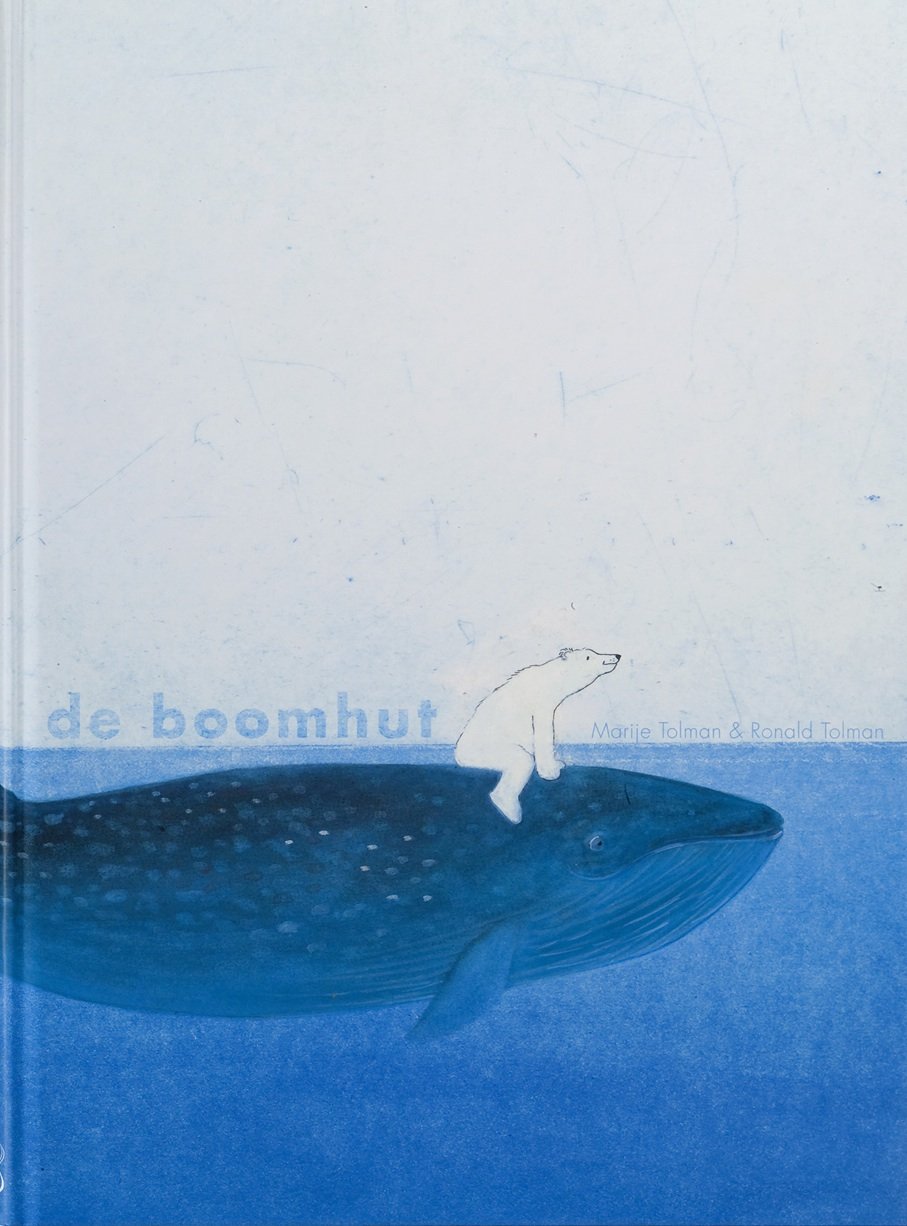
A polar bear riding a whale in the ocean. Hmmm. Polar bear…check. Whale…check. Ocean…check. This must be a book about global warming and species extinction. The cover of The Tree House (de Boomhut) certainly suggests this possibility, although I’m not quite sure what a polar bear riding on the head of a whale signifies.

In the opening pages of this stunning (and wordless) picture book, a polar bear and a brown bear climb a treehouse in the middle of the ocean. After some exploration of their new abode, they do what any two bears would do in a treehouse: make toast and crack open some books. However, a tree house in the ocean is a tough thing to conceal, and soon the flamingos arrive, followed by a hippo, a couple of panda bears, owls, crows, and the ultimate party crasher, a rhino. Although welcoming, the two bears spend a lot of time looking off into the distance while the locals make merry in the branches of the treehouse. Yes, even introverts, introverted bears, have parties. As the guests disperse, the story ends. There is no follow-up page with warnings about pollution and the necessity of conservation, or the tragic plight of the polar bear. Sometimes a Tree House is just a treehouse? Surely not.

Read More

  • Posted on May 24, 2010

Monkey Love

Gorilla in our midst

I’ll go out on a limb (without a prehensile tail, I might add) and state, unequivocally, that Anthony Browne is the best monkey artist of all time. Perhaps if Van Gogh had painted a field of monkeys instead of a field of sunflowers, I would have reason to adjust my statement, but he didn’t, and so Browne is, and will always be, the King of Kongs.

One of my earliest memories of working in the bookstore was a woman flapping a copy of Gorilla by Anthony Browne in my face and vehemently stating, ‘This book is about child abuse, and it should be removed immediately!” I had not read the book, but as I flipped through it with the woman hyperventilating beside me, I felt like thanking her. Of course it wasn’t about child abuse and I didn’t remove it, but from that point on I became a fan of Anthony Browne.

Read More